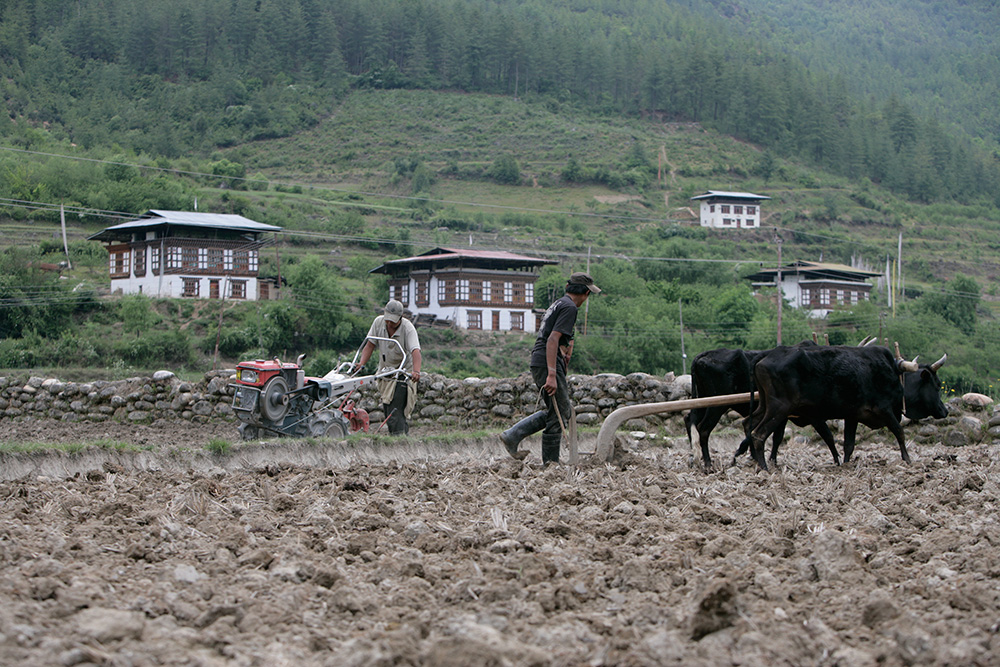
Bhutan has three distinct climatic zones corresponding broadly to the three geographical divisions – hot and humid southern belt, cool temperate central zone, and alpine northern region.
The steep and unstable terrain and the relatively young mountain system, however, render the country to be ecologically very fragile. Agricultural production is also severely constrained, as only around 3% of the land area is cultivable. Bhutan is also endowed with a river system that has an estimated potential to generate 30,000 MW of hydroelectricity.
Geography
Bhutan is a small landlocked country in the Eastern Himalayas bordered by China in the North and India on the other three sides. It has a total land area of 38,394 sq. km. and measures approximately 150 km north to south and 300 km east to west. The landscape is characterized by rugged terrain and steep mountain valleys ranging from 150 meters in the sub-tropical valleys in the southern foothills, through temperate zone to heights exceeding 7,000 meters in the alpine regions of the mountains.